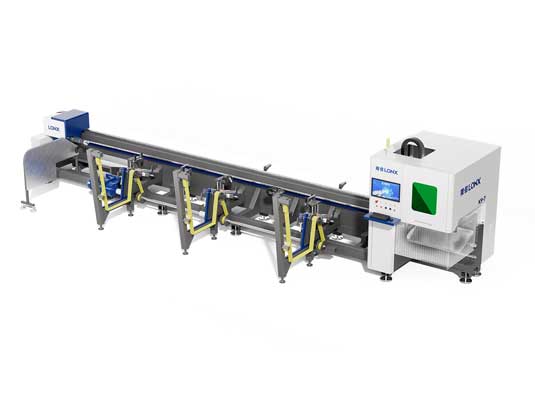
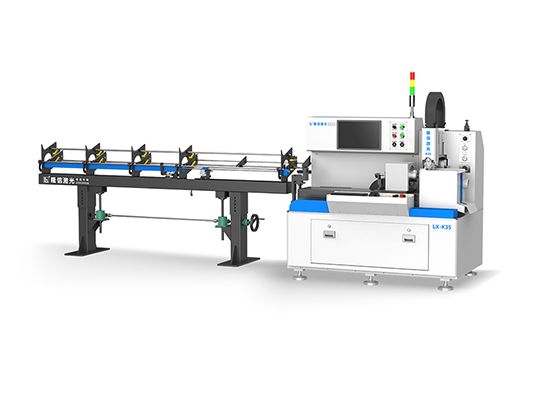
In precision metal tube and bar manufacturing, edge preparation is often a critical bottleneck. Burrs, sharp edges, and uneven tube ends not only cause downstream welding defects and assembly failures, but they also compromise workplace safety. While single-head machines or manual deburring tools were once common, high-volume production facilities are transitioning to dual-end hydraulic automation.
If you are evaluating your workshop workflow, this guide explains exactly why choosing a hydraulic double-head chamfering machine delivers higher throughput, superior repeatability, and a faster return on investment (ROI).
What Is a Hydraulic Double-Head Chamfering Machine?
A hydraulic double-head chamfering machine is a specialized industrial pipe-finishing machine engineered to simultaneously bevel, chamfer, and deburr both ends of a metal tube or solid bar in a single cycle.
Unlike pneumatic or manual benchtop tools, hydraulic machines utilize continuous, high-pressure fluid power to drive rigid clamping vices and balanced tool cutter heads. This configuration simultaneously processes the inner edge (ID chamfering), outer edge (OD chamfering), and flat face (facing) of both tube ends, ensuring concentric uniformity and surface smoothness.
200%+ Productivity Boost via Simultaneous Dual-End Finishing Traditional single-head machines require operators to chamfer one end, manually flip the heavy pipe, re-clamp, and process the second end. A double-head chamfering machine processes both ends at the same time:
Halves total cycle time per workpiece.
Eliminates material turnaround and secondary handling.
Smoothly integrates with automatic bundle loaders and output sorting conveyors for non-stop mass production.
Heavy-Duty Clamping Force and Anti-Deformation Stability Hydraulic power systems provide steady, adjustable clamping force far superior to pneumatic setups:
Handles thick-wall structural pipes and solid steel rods without slippage.
Precise hydraulic proportional valves allow controlled clamping pressure on thin-walled stainless steel or copper tubes without crushing or oval distortion.
Dual-action hydraulic vices lock the workpiece firmly close to the cutter head, dampening tool chatter and extending carbide blade life.
Exceptional Repeatability and Precision Tolerances In automotive, heat exchanger, and furniture fabrication, tube length and end-face squareness require tight tolerances:
Simultaneous internal, external, and facing cuts ensure balanced cutting resistance across both tube ends.
Rigid linear guide rails combined with hydraulic micro-feed cylinders maintain axial length tolerances within +/- 0.05 mm.
Produces clean, weld-ready bevels and smooth chamfers ready for robotic assembly, O-ring insertion, or hydraulic fitting crimping.
Comprehensive Material Versatility Hydraulic double-head chamfering machines effortlessly handle a wide spectrum of materials:
Carbon steel (seamless and welded pipes)
Stainless steel (304, 316, 409)
Aluminum alloys and brass
Titanium and high-nickel structural alloys
Round tubes, square tubes, oval pipes, and solid round bars
Reduced Labor Dependencies and Lower Operating Overhead By automating end-finishing with a hydraulic dual-head platform, a single operator can oversee multiple cells:
Lowers manual handling risks and repetitive strain injuries.
Eliminates costly manual deburring, grinding, and secondary polishing.
Replaceable indexable carbide inserts reduce tooling replacement downtime to minutes.
Process Comparison: Hydraulic Double-Head vs. Single-Head & Manual Finishing
Metric / Factor: Processing Time
Manual / Hand Grinding: 30 - 60 seconds per tube
Single-Head Chamfering: 10 - 18 seconds (requires flipping)
Hydraulic Double-Head: 3 - 6 seconds (both ends finished simultaneously)
Metric / Factor: End-Face Symmetry
Manual / Hand Grinding: Inconsistent, high operator variance
Single-Head Chamfering: Variable concentricity between ends
Hydraulic Double-Head: 100% symmetric and uniform concentricity
Metric / Factor: Heavy-Wall / Solid Bar Capability
Manual / Hand Grinding: Extremely low efficiency, hazardous
Single-Head Chamfering: Moderate; limited by pneumatic clamp force
Hydraulic Double-Head: Outstanding; robust hydraulic torque and clamping
Metric / Factor: Length Consistency
Manual / Hand Grinding: Poor (+/- 1.0 mm or worse)
Single-Head Chamfering: Moderate (+/- 0.2 mm)
Hydraulic Double-Head: Precision repeatable control (+/- 0.05 mm)
Primary Industrial Applications
Investing in a hydraulic double-head chamfering machine is standard practice across industries demanding rigorous end-finish tolerances:
Automotive Exhaust & Chassis Components: Muffler tubes, suspension links, drive shaft tubing, and crossmembers.
Metal Furniture & Lighting Hardware: Office chair frames, fitness gear columns, display racks, and table legs.
Heat Exchangers & Boilers: Clean ID/OD chamfering of condenser and boiler tubes to facilitate automated tube-to-tubesheet expansion and orbital welding.
Hydraulic Cylinder Tubes & Fluid Lines: Removing internal micro-burrs to prevent fluid circuit contamination and seal erosion.
Construction & Scaffolding Structures: Heavy structural scaffolding pipes requiring clean, burr-free end joints for modular interlocking.
Essential Features to Look for When Choosing a Machine
To maximize return on investment, ensure the hydraulic double-head chamfering machine incorporates the following engineering details:
Independent Variable Speed Drive (Inverter/VFD): Allows independent spindle speed adjustments to match varying pipe diameters and material hardness.
Rigid Steel Machine Bed: Stress-relieved annealed base frame to isolate cutting vibration and maintain alignment over years of two-shift operation.
Multi-Angle Cutter Heads: Accommodates indexable carbide inserts capable of 30 degree, 45 degree, and custom radius (R-angle) beveling.
Intuitive PLC Touchscreen: Enables fast recipe recall, clamp timing regulation, and automated troubleshooting diagnostics.
Chip Conveyor Integration: Automatic scrap removal system to prevent metal filings from building up around hydraulic clamping jaws and guide rails.
Q1: What is the main difference between hydraulic and pneumatic double-head chamfering machines? A1: Hydraulic machines use pressurized hydraulic fluid, providing significantly higher clamping pressure and smoother tool-feed damping. This makes hydraulic units the preferred choice for heavy-wall pipes, solid bars, and tough alloys like stainless steel. Pneumatic machines use compressed air and are best suited for light-gauge, small-diameter tubes with light deburring requirements.
Q2: Can a double-head chamfering machine process short and long tubes on the same machine? A2: Yes. Double-head machines feature one fixed spindle head and one moveable spindle head driven along precision linear guide rails. Operators can adjust the distance between heads within minutes to handle tube lengths ranging from short bushings (e.g., 50 mm) to long tubes (up to 3,000 mm or more).
Q3: Does chamfering both ends simultaneously cause tube twisting or vibration? A3: No. Properly designed hydraulic machines utilize synchronized dual-vice clamping mechanisms positioned immediately behind each cutter head. The counter-balanced rotational forces and rigid clamping eliminate workpiece vibration, axial movement, and torsion.
Q4: How does end-chamfering improve automatic robotic welding? A4: Robotic welders require uniform root faces and joint gaps. A hydraulic double-head chamfering machine creates flat end faces and precise ID/OD bevel angles, ensuring consistent weld puddle penetration and eliminating weld blow-through or porosity.
Final Takeaway: Is a Hydraulic Double-Head Chamfering Machine Right for You?
If your workshop processes more than 1,000 tubes per shift, struggles with uneven manual deburring, or needs ready-to-weld tubes for downstream automated lines, the answer is clear. Choosing a hydraulic double-head chamfering machine slashes processing cycle times, eliminates operator error, and delivers the consistent edge finish required by modern manufacturing standards.
Ready to optimize your tube end-finishing line? Contact our technical engineering team today for custom tooling recommendations, cycle time simulations, and detailed equipment proposals.