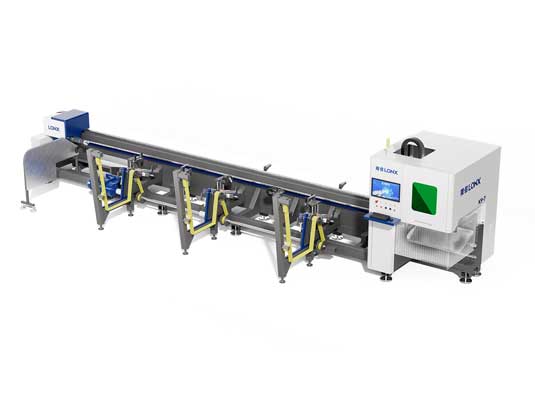
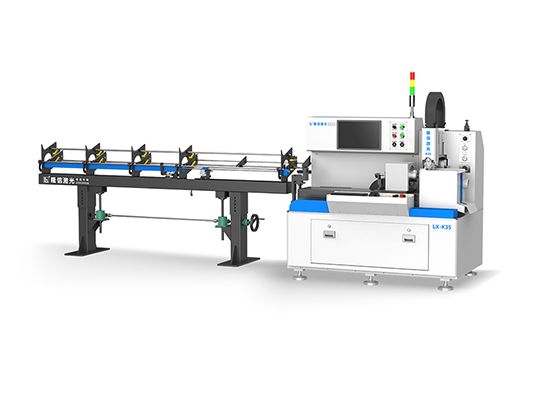
In the modern metal fabrication industry, efficiency, precision, and material utilization dictate a manufacturer’s competitive edge. Traditional pipe processing methods—relying on circular saws, band saws, mechanical punch presses, drilling rigs, and manual notch grinders—are labor-intensive, slow, and prone to dimensional errors.
The introduction of CNC fiber laser tube cutting machines (commonly referred to as tube lasers) has revolutionized this sector. By integrating cutting, drilling, slotting, contouring, and beveling into a single continuous automated operation, tube lasers have redefined pipe fabrication standards across global industries.
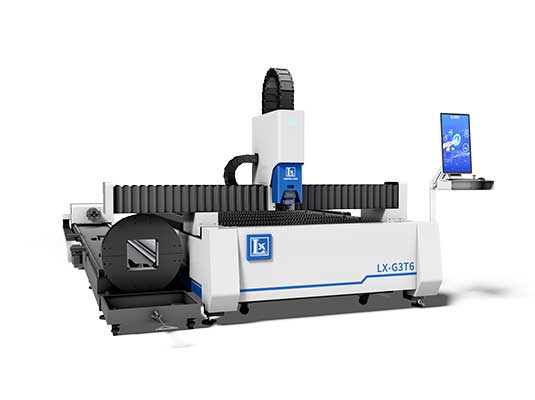
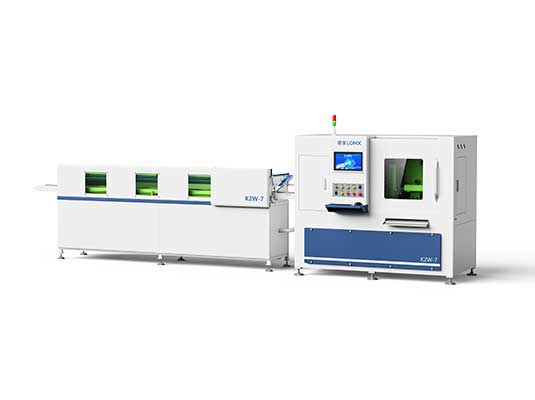
A tube laser is a specialized CNC (Computer Numerical Control) machine tool designed to cut hollow structural sections, tubes, and open profiles with extreme precision using a focused fiber laser beam.
Unlike traditional flat-sheet laser cutters that operate exclusively across flat two-dimensional (X/Y) planes, a tube laser integrates high-speed rotary axes (C-axis chuck rotation) with multi-axis synchronized linear movement (X, Y, Z). This spatial synchronization allows the laser cutting head to process round tubes, square tubing, and irregular structural geometry continuously along their length.
Tube lasers handle virtually all common metals used in industrial manufacturing:
Carbon Steel / Mild Steel: Structural tubing, machinery frames, and pipelines.
Stainless Steel (304, 316, etc.): Sanitary piping, architectural handrails, and medical equipment.
Aluminum Alloys: Lightweight automotive components, ladders, and aerospace frames.
Brass and Copper: Conductive busbars, decorative accents, and plumbing fittings.
Galvanized Steel: Fencing, greenhouse frameworks, and outdoor construction posts.
A modern tube laser combines mechanical engineering, laser physics, and intelligent CAD/CAM nesting software:
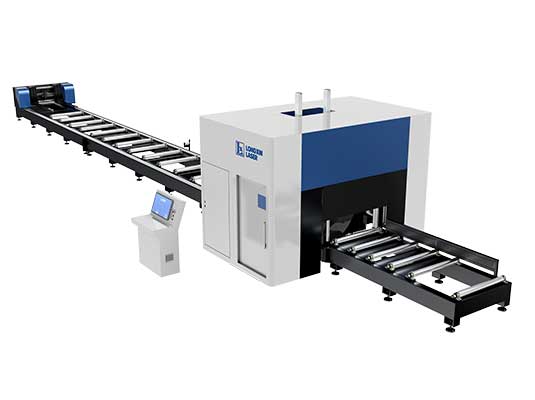
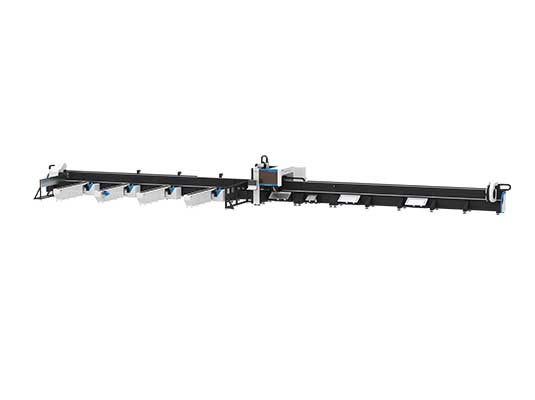
Material Feeding & Clamping: Raw pipe lengths (typically 6 meters, 9 meters, or 12 meters) are fed into the machine via an automatic bundle feeder. Pneumatic or hydraulic self-centering chucks grip the tube securely without causing surface deformation on thin-walled profiles.
Dynamic Laser Machining: As the chucks rotate the pipe at high RPM, the laser cutting head moves dynamically along the profile. Assist gases—such as High-Pressure Nitrogen (for clean, burr-free cuts on stainless steel and aluminum) or Oxygen (for thick carbon steel)—blow molten metal out of the cut kerf instantly.
Smart Unloading: The CNC system discharges finished cut components via pneumatic support conveyors, while separating tailing remnants into scrap bins.
Modern fiber tube lasers are engineered to handle a broad range of profiles beyond basic round tubing:
| Profile Category | Typical Shapes & Geometries | Common Applications |
| Standard Closed Tubes | Round pipes, square tubes, rectangular box sections | Handrails, furniture frames, agricultural booms |
| Special & Oval Profiles | Flat oval, elliptical, D-shape, triangle, hexagon | Fitness equipment, automotive frames, exhibition racks |
| Open Structural Shapes | Angle Iron (L-Shape), Channel Steel (U/C-Channel), I-Beams / H-Beams | Heavy steel construction, trailer chassis, storage racks |
Saddle Joints / Fish-Mouth Cuts: Enables seamless T-joint and multi-angle branch connections for welded frame assemblies.
Slot-and-Tab Interlocking Design: Cuts tongue-and-groove joint tabs directly into tube ends, allowing self-locating assembly before welding without measuring fixtures.
3D Bevel Cutting (up to ±45°): Chamfers structural steel and heavy pipe joints in-line, eliminating manual edge grinding for deep-penetration welding.
Investing in a dedicated fiber laser tube cutting machine provides significant operational advantages over conventional sawing and punching:
Elimination of Multi-Station Handling: A single tube laser replaces up to five distinct machines (saw, drill press, punch press, deburrer, and milling machine). Tubes are loaded as raw stock and unloaded as finished, weld-ready components.
Superior Cut Quality & Accuracy: Delivering repeatability within ±0.05 mm, laser cuts leave clean, dross-free edges that eliminate manual deburring and secondary grinding.
Zero-Tailing Technology: Advanced three-chuck and four-chuck configurations can clamp, hand off, and cut along the full stock length, reducing end-tailing scrap to zero. On expensive materials like stainless steel and brass, this yields massive annual raw material savings.
Tooling-Free Production Flexibility: Switching between pipe diameters, slot patterns, or hole geometries requires only loading a new DXF/STEP CAD file into the nesting software—zero die changes, zero physical punch tooling, and zero setup downtime.
Accelerated Downstream Assembly: Because laser-cut holes and tabs align with exact tolerance, downstream welders assemble parts up to 50% faster, cutting shop labor overhead dramatically.
Fiber laser tube cutting machines serve a wide spectrum of modern manufacturing sectors:
Fitness & Sports Equipment: Pin adjustment holes, seat post brackets, and complex-angle joints for weight benches, multi-gym stations, and power racks.
Architectural Metalwork & Handrails: Staircase handrails, commercial guardrails, security gates, and spatial structural trusses.
Automotive & Transportation: Exhaust manifolds, chassis roll cages, truck seat structures, and bus framework sub-assemblies.
Agricultural & Heavy Machinery: Harvester frames, spray booms, tractor cabins, and earthmoving implement supports.
Metal Furniture & Commercial Displays: Ergonomic desks, hospital beds, retail display shelves, and heavy-duty warehouse racking.
When selecting an industrial tube laser, evaluate your production requirements against four primary machine criteria:
Chuck Clamping Range (OD):
Small to Medium Pipes (15 mm to 160 mm / 220 mm): Ideal for furniture, fitness gear, handrails, and automotive parts.
Heavy-Duty Profiles (200 mm to 350 mm / 500 mm+): Required for structural steel, heavy machinery, and industrial oil/gas pipeline fabrication.
Laser Power Rating:
1.5 kW – 3 kW: Optimum speed and cost-efficiency for thin to medium walls (1.0 mm to 5.0 mm).
4 kW – 6 kW+: Essential for thicker walls (6.0 mm to 12.0 mm+) and high-speed reflective metal processing.
12 kW – 20 kW: Heavy structural beams and thick-walled pipeline beveling.
Chuck Configuration (Tailing Waste Control):
Standard two-chuck models are economical for general fabricators.
Three-chuck and four-chuck synchronized systems are recommended for zero-tailing needs and long, heavy pipe processing.
Automation Level:
High-mix, low-volume job shops often succeed with semi-automatic side loaders.
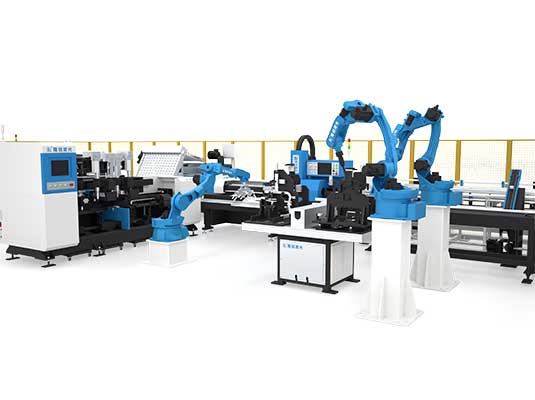
High-volume contract manufacturers benefit substantially from fully automated bundle feeding systems to maintain 24/7 continuous throughput.
A fiber laser tube cutter is a transformative investment that reduces labor dependency, lowers production lead times, and expands processing capabilities.
As a dedicated manufacturer of industrial CNC fiber laser cutting equipment, we engineer specialized tube laser systems ranging from compact, high-speed machines to heavy-duty, multi-chuck structural tube processing lines.
Contact Lonx engineering team today to discuss your tube dimensions, request custom sample cutting tests, or receive a tailored machine layout and quotation.